Living in Tahoe, frequent disc golf play is impossible from around November through March. This is not optimal for someone who will be going on tour for the upcoming season.
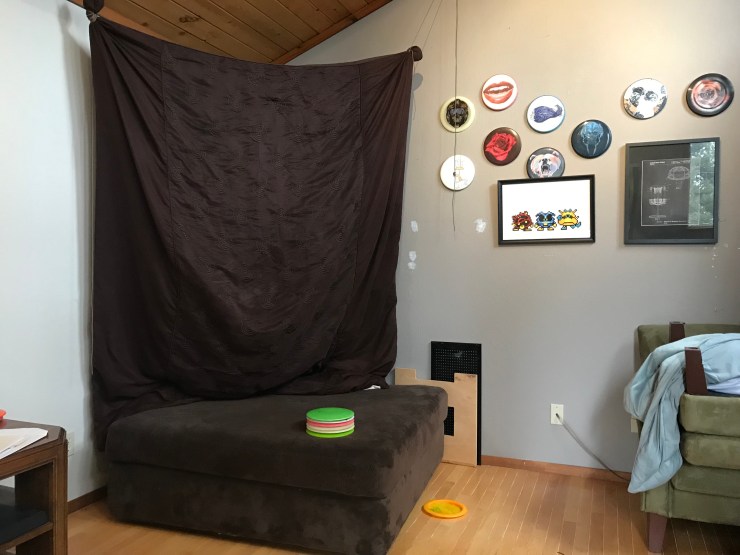
So to help prepare for the 2019 season, I installed an indoor throwing net. It’s simply a comforter hung by 2 screw hooks in the ceiling. I love this setup. It’s in my home, the room has speakers, and I get to throw plastic to my heart’s content.
During this process I have come to realize many benefits of throwing a disc only 15 feet. The main 3 areas that I have seen drastic improvements are:
~Exercise
~Mental Focus
~Form Work
~Exercise
Unlike field work, this setup allows for quick repetition of throwing. In the field it takes about 5 minutes in between throwing intervals. Using the net, I can throw 50 full power drives in 10 minutes or less. The short intervals between throws and being able to throw full power has helped me build muscle and stamina.
~Form work
By not being able to see the full flight of the disc, my concentration is paying strict attention what my body is doing for each throw. This has been very helpful for me to dial in on how my form feels. By using a camera to record the throws, I compare how my form feels to what it looks like. Am I reaching too far behind me which emphasizes early releases? Am I dropping my shoulder instead of driving my elbow through my body? The footage answers these questions and helps me recognize and implement key focal points during my throw.
Each session I start with slow standstill shots, then move to a 3 step approach, and finally full power. This progression in speed allows me to hone in on key my mental points during the throw, and maintain my intention as I throw faster and harder.
~Mental focus
Through repetition of only driving 10 feet, the benefits are not only physical, but also mental. For each throw, I execute a routine…
- Breath
- Lineup my approach and set the angle of the disc
- Focus on my form throughout the throw
- Visualize what the shape of the flight would be if I was on the course
By following these steps, I can establish a meditative visualization of how I want the disc to fly by focusing on how my form feels and looks when I review the recorded footage. This routine helps me stay grounded and allows me to envision the process and the desired outcome for every throw.
There are drawbacks to this system however. By not seeing where the disc is flying, I have no idea where the disc is going to go… duh…
The second, and most crucial part of the find x equation is field work. Field work is the actualization of all of the repetitions and visualization. It helps determine the angles and distance that can only be presumed when throwing into a net. The field also allows for repetition to understand and become confident with every disc and throw in your bag.
There are drawbacks to this system, however. By not seeing where the disc is flying, I have no idea where the disc is going to go… duh…
The second, and most crucial part is to throw practice shots in the field: field work. Field work is the actualization of all of the repetitions and visualization. It helps determine the angles and distance that can only be presumed when throwing into a net. Field work is necessary to understand and become confident with every disc and throw in your bag.
I equate this routine to a musician preparing for a concert:
- Practice, practice, practice: Focus on each note, phrase and the technique to understand the piece, and do it over and over and over and over… (Drives into a net)
- Apply the practice in an overarching setting: Apply the phrasing and hone in on the true character of the piece (Field work)
- The performance: By preparing beforehand, the artist isn’t focusing on the technique or the how they want it to sound because it is already ingrained. It is all second nature. (Tournament)
This analogy is very similar to competing in a disc golf tournament. The routines and habits are set long before the two minute warning or the concert.

By taking a step by step approach, I have really started to picture what every throw should look and feel like before stepping up to my shot. Ask anyone that I have disc golfed with and they’ll tell you that my form was unique to say the least. Rounding, and as a result, early releases were always an issue. This routine has helped me restructure how I lineup and focus on form, I can visualize my line much cleaner and execute at a higher level.
 Discy Business